
A faithful quote does not verify a fact
Audio, transcripts and external documents answer different questions. Practise reviewing a quote before a plan becomes a completed event in the headline.
2026-09-25 · 1.0 · PL / EN
01 / Three questions before publication
A sentence can repeat a transcript exactly and still mislead readers. Speech recognition may have mistaken a name. The speaker may have given the wrong number. An editor may have turned a cautious statement into a confident headline. One green indicator cannot settle all three problems.
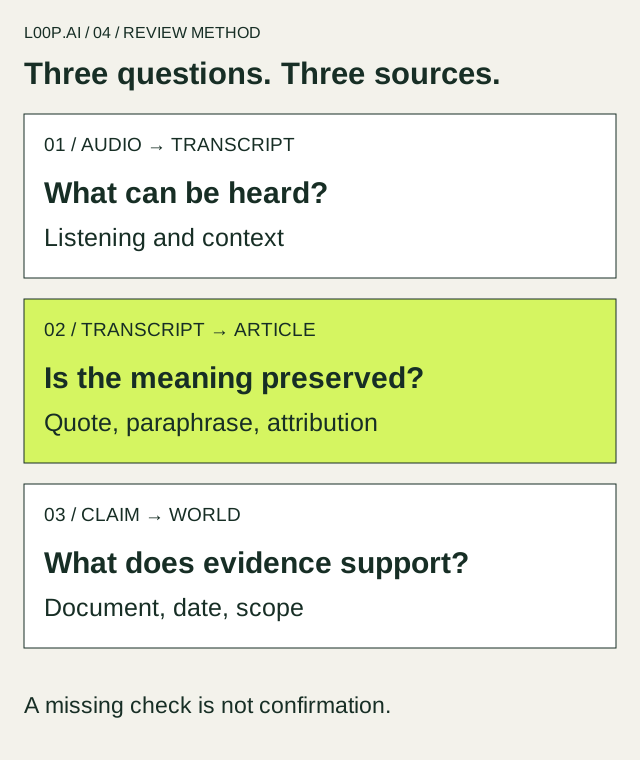
We propose checking separately: whether the transcript matches the audio, whether the article preserves the speaker's meaning, and whether a claim about the world has evidence. Each check needs a different source. A recording establishes what was said; it does not automatically establish that the speaker was right.
This is a public working method adapted from workshop documentation. The source policy remains labelled a draft; its adoption by the editorial board has not been confirmed. We do not present it as the newsroom's established policy. This resource supplements the Szpieg+ guide with a quote-review exercise; it does not describe a new product deployment.
02 / Fictional example: a plan becomes a result
Every person, document and statement in this exercise is invented. No demonstration recording was made: the following is a written scenario, not a transcript of a real conversation.
The assumed speaker says: “We plan to open in May. We do not yet have approval. According to the preliminary estimate, it will cost nine million.” An invented automated transcript drops “not” and changes nine to ten. The article receives the headline: “Facility opened in May for ten million.”
Several different changes have occurred. A plan became a completed event. The absence of approval disappeared. The amount came from a faulty transcript, and a preliminary estimate became a final cost. Matching the article against the faulty transcript may fail to detect some of these problems.
In a further version of the exercise, the editor receives a fictional, later-dated document: the current estimate is eight million. The number inside the quote must not be replaced with eight. Preserve the fact that the speaker said nine; put the update separately, with its date and document reference. In real work, first establish that both documents cover the same scope and type of amount.
A more cautious headline for this scenario is: “May opening planned; approval still required.” This follows the exercise's assumptions; it is not a ready-made headline for a real project. If the current approval status is unknown, attribute that information to the speaker and preserve the time of the statement.
03 / From audio to transcript
Listen to the passage with context before and after the selected sentence. Pay particular attention to negation, names, numbers, units, dates and speaker changes. A timestamp helps locate a passage but does not prove that a quote is accurate. Check that it points to the correct recording and still identifies the same passage after editing.
Preserve the original file and initial transcript. Record a correction as a separate version with its time range, reason and reviewer. Do not erase the evidence that the automated system heard something else. A trimmed copy needs a time map back to the source.
A second speech-recognition system may reveal a disagreement, but agreement between two systems does not replace listening. Both may make the same mistake. A historical error measurement from one sample cannot be transferred to every new recording. If a word remains unclear, do not insert the most likely wording as a certain quotation.
04 / From transcript to article
A quotation and a paraphrase serve different purposes. Readers expect a quotation to contain the speaker's words. A paraphrase lets the editor express the meaning differently, but not change certainty, time, actor or scope.
Removing a speech disfluency requires checking meaning. Repetition may be accidental, but it may also express emphasis. Negation and qualifications remain significant. If the newsroom permits shortening quotes, mark omissions under its explicit convention and do not join distant sentences as if they were one uninterrupted statement. For translation, retain the original, identify its language, disclose the translation and arrange a meaning check.
A voice match is a clue, not sufficient confirmation of a name. A rejected identity must not survive as a job title copied from the same mistaken record. Even a speaker's role needs a source, such as an introduction in the programme. If the role is also unknown, record that identity remains undetermined.
The file boundary is not the broadcast boundary. A conversation before going on air may be in the same recording. Before using a passage, establish whether it was broadcast and whether there is a basis for publishing it. Possession of an archived file does not settle usage rights.
05 / From a statement to an established fact
Start fact-checking by spelling out the claim: who did what, when, within which scope and on what basis. “Submitted an application” does not mean “received a decision”; “planned” does not mean “completed”. Read the primary document and its date. Two websites repeating the same announcement are not two independent confirmations.
Present information from outside the conversation as a clearly marked editorial note, with its source next to the relevant passage. Do not silently rewrite the speaker's words. A URL alone does not prove support: check content, scope, currency and any subsequent correction.
For an allegation, distinguish the fact that it was made from the truth of its content. Preserve attribution, examine evidence and seek the position of the person concerned. Describe the actual outcome of contact, not a token attempt. Adding “according to the speaker” does not resolve every publication issue. This article proposes editorial practice; it does not replace legal assessment of an individual case.
Check the headline, lead and image caption separately. These are places where a cautious sentence can easily become an overconfident claim. Someone reading a social-media card may never see the qualification at the end of the article.
06 / What automation can check
Comparing two texts may help detect an unsupported number, changed name, removed negation or drift from a question into an assertion. A natural-language inference model evaluates the relationship between a supplied premise and hypothesis. The XLM-R XNLI model card illustrates that input pattern. This is neither a comparison against audio nor an independent investigation of reality.
Proposed operating rule: an unavailable service, incomplete source or software exception produces “needs review”, not “confirmed”. Record which check was not performed. “No supporting passage found” is not equivalent to “proved false”: the system may have received the wrong excerpt.
Evaluate a tool with paired examples. Rewriting “nine million” as “9 million” should be distinguished from replacing it with “10 million”. “We do not have approval” must not receive the same assessment as “we have approval”. These are proposed future test cases, not results from a model run for this article.
Monitor false alarms too. A list that calls an ordinary date-format change a fabrication can train editors to ignore warnings. Reducing excessive sensitivity must preserve checks for real changes in number, person and meaning. Do not change a rule merely to make a particular article pass.
07 / A review record for one sentence
For each important quote or claim, retain a short record from which another editor can reconstruct the decision.
- Sentence version: exact wording, quote or paraphrase, and location in the article.
- Source: recording identifier, time range, context and transcript version.
- Listening check: what was checked, by whom, and what remains unknown.
- Speaker: basis for identification or an explicit unresolved status.
- External facts: document, date, exact location and scope of support.
- Decision: retain, correct, attribute as a statement or remove; reason and responsible person.
Finally, read the whole article, not only passages changed after a warning. Check that notes do not contradict the headline and that a replacement illustration still has the right caption. Describe substantive post-publication corrections with dates; retain the previous version and evidence under access appropriate to their confidentiality. Set the retention period separately rather than deriving it from this exercise.
08 / What this edition checked
Four internal sources were read: the draft policy and checklist version 0.1 dated 12 September 2026, the test record from that day, and the architecture decision on fidelity checks. The documents are not fully consistent: the draft includes a later illustration decision absent from the checklist. The test record also uses wording about checking against a recording, while the draft explicitly distinguishes text-to-text checking from listening. We therefore do not carry those statements forward as evidence of the product's current capabilities.
We publish no historical quality figures, private identifiers, details of the real case or claims about its present status. A standalone method guide was chosen instead of modifying the accepted product guide. Confirmation of policy adoption, new performance measurements and renewed production acceptance are outside this edition's scope.
Codex created the original written scenario and diagram in code. The PL/EN text received author review, not an independent second-model review. For this L00P.AI publishing series, the user authorised agent publication with post-publication withdrawal; this does not change the rules for publishing broadcast articles on the newsroom's portal. Errors in the method or example, or material changes to source documentation, trigger correction.