
A successful render is not an accepted production
Cuts, sources and the finished export need separate acceptance checks. A checklist and an actual synthetic WAV sample test.
2026-09-26 · 1.0 · PL / EN
01 / Repeat the check, not the mistake
The file exists, the player opens it and its duration seems reasonable. Yet a speaker starts halfway through a thought, the introduction repeats a name and a caption hides an important detail. Repeatable production starts by defining acceptance criteria before editing.
Our starting point is an archived production doctrine written after two runs. It described rendering problems and proposed testing an improved workflow on another episode. This is a record of lessons, not evidence of readiness today. We develop it into a working method and add our own narrowly scoped technical trial.
02 / Freeze inputs and decisions
Preserve the original recording and its checksum. Check the file's actual duration and properties before assuming it contains the entire conversation. A successful export cannot repair a missing source ending.
An edit decision list, or EDL, should identify the source, IN/OUT boundaries and a reason for each cut. Record the transcript version and the person or agent proposing the change. A human approves decisions requiring editorial judgment. A transcript helps locate a passage; listening establishes its sound and meaning.
When an accepted input changes, create a new decision version. Resuming a render may skip only fragments matching the same source, EDL and settings. An output file's existence alone does not establish that it can be reused.
03 / Word boundaries are not meaning boundaries
Word timestamps help propose a cut. They do not guarantee a clean phonetic boundary or a complete thought. Listen to the beginning, ending and surrounding quotation. Resolve a conflict by changing the selection or allowing more time, rather than cutting mechanically after a fixed number of seconds.
An introduction should add context. If the recording already identifies the participant, an additional narrator need not repeat it. Removing a question can also change an answer's meaning. Shorter does not automatically mean better.
The source specifies introduction lengths and pacing rules. We retain these as historical choices for that production. We have no measurement supporting their presentation as a universal way to retain an audience's attention.
04 / What we actually measured
On CzarneNiebo we created a five-second synthetic tone: mono, 16-bit PCM, 48,000 samples per second. FFmpeg extracted samples from 48,000 inclusive to 120,000 exclusive. The result contained exactly 72,000 samples, or 1.5 seconds.
Comparing PCM data confirmed that every output sample matched the selected input range. Both files and their checksums were preserved. This tests slicing that WAV, not sentence detection, listening quality or conversation editing. No human voice was used.
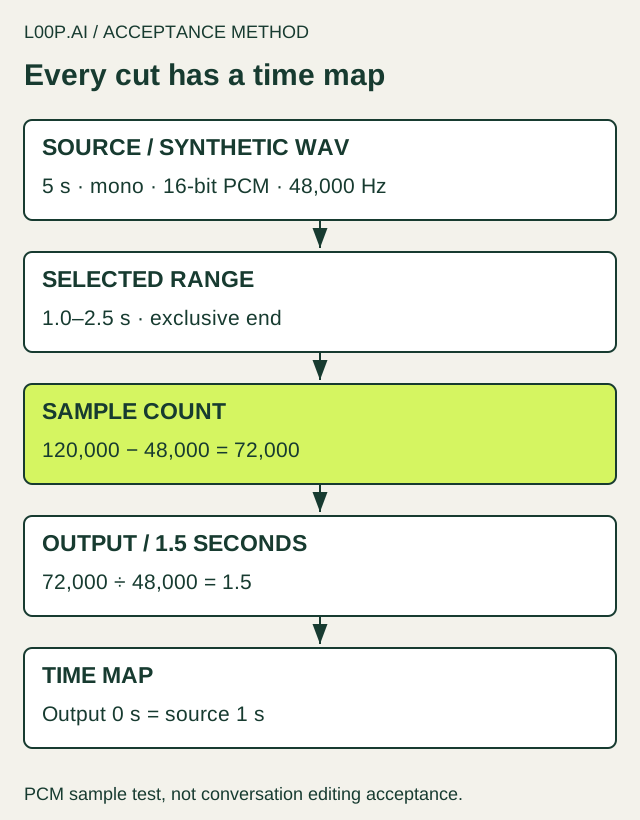
The time map says that the output starts at source second 1 and ends at the 2.5-second boundary. UTC describes when an operation happened; position within a file derives from samples. One must not be presented as evidence of the other's accuracy.
05 / Choose parameters for the edition
The historical doctrine specified one set of loudness and export targets. For a new assignment, establish the distribution channel, recipient requirements and master properties, then measure them. Configuring a normalization filter is insufficient: acceptance concerns the finished file.
Record integrated loudness, true peak, format, sample rate, channel count and duration. For pictures, add resolution, frame rate and caption readability on a phone. Acceptance thresholds and tolerances must be known before assessment.
Do not automatically extend a PCM trial to MP3, AAC or video editing. Decoding, encoding and frame boundaries require separate checks. A processed copy should not replace its source. Distribution files and masters may have different requirements.
06 / One audience's attention
Avoid placing several competing text layers in the same area. Inspect captions, speaker labels and context cards together at the intended aspect ratio. Each layer being correct separately does not guarantee that their combination is readable.
Disclose synthetic content according to its actual nature. The historical assertion that an end card alone establishes legal compliance is too categorical. A separate resource explains permission, synthesis and disclosure.
Editorial review also covers the title, thumbnail and short trailer. A question mark does not neutralize a misleading suggestion. Check that an excerpt preserves context and that cutting an answer does not assign a different position to its speaker.
07 / A reusable acceptance checklist
- Input: preserve the source, verify checksum and duration, establish rights and permitted use.
- Decisions: record the EDL version, justification for every cut, time map and necessary approvals.
- Content: listen to boundaries, names, numbers and context; avoid redundant introductions.
- Sound: measure the finished export against previously recorded targets; disclose missing measurements.
- Picture: inspect captions and cards together on large and small screens; include disclosure where needed.
- Release: play the beginning, middle and ending; check completeness, versions, links and withdrawal arrangements.
Each item needs a result, evidence and the person or agent who checked it. “Not checked” remains a separate state. To prepare such a card for your production, we can start with one example episode and its recipient's requirements.
08 / Provenance and limits
We read the complete archived doctrine preserved in a source read dated 25 September 2026. A current ZBook read was unavailable. We do not confirm historical reviewer assessments or completion of the next trial proposed in that document.
The PCM trial ran on 26 September 2026; filter parameters were also checked in the installed FFmpeg help. Codex prepared PL/EN, the diagram and author review. There was no independent second-model review, listening test of a real conversation or audit of the entire production workflow. Changes to the source, tool or parameters, and discovered errors, trigger another check.