
An introduction helps, but does not confirm identity
How to introduce speakers, frame clips and review attributions. Practical templates and a narrow test showing the limits of automatic checks.
2026-09-26 · 1.0 · PL / EN
01 / One sentence for the listener and editor
A conversation starts with “hello”, followed by two voices talking for fifteen minutes. Who is hosting and who is answering? Someone in the studio knows. A listener who joined later, or an editor preparing a quotation, may not.
Introduce yourself and name your guest immediately before handing over. A first name, surname and agreed role give the conversation structure. They are not a magic phrase that makes a system label every statement correctly. An introduction can be misheard, mistranscribed or assigned to the wrong voice.
This guide develops an internal handbook for presenters dated 18 September 2026. It preserves the radio practice while separating it from system-specific parameters and promises of automatic accuracy. Examples are fictional templates, not broadcast quotations.
02 / A speaker number is not a name
Transcription records words. Diarization divides a recording into segments assigned to distinguishable voices. Identification attempts to connect a voice to a particular person. pyannoteAI's explanation distinguishes anonymous speaker labels from identification using reference profiles.
The label “speaker 2” contains no name. A name spoken in a sentence need not belong to the person speaking. A host may introduce a guest, a guest may mention a book's author, and both may listen to an archival clip. The relationship between words, voice and recording time must be established.
Keep the original audio and a reference to the relevant passage. Text helps locate the moment. Listening lets you check what is actually audible; it does not resolve every uncertainty about identity by itself.
03 / Introduce people when the voice changes
Before recording, establish the spelling and pronunciation of names and the agreed description of each role. Do not supply a title from memory. Adapt these templates:
- Opening: “Hello, this conversation is hosted by Anna Nowak.”
- Guest entry: “My guest is Jan Kowalski, the project coordinator. Where did you begin?” Then leave room for the answer.
- Second guest: “Now I will hand over to Ewa Zielińska.” Do not introduce several people as though the following answers automatically establish their order.
- Return: “We are back with Jan Kowalski.” Repetition also helps someone who has just tuned in.
A natural pause helps separate the question and answer. We give no universal duration: it depends on the conversation and connection. A clear introduction serves people, rather than asking them to recite model commands.
04 / Mark breaks, clips and corrections
Restore context after a break or change of host. If recordings are split into files, check whether every passage you use retains participant information. Do not assume that a name recorded earlier automatically carries over to the next file.
Frame a clip verbally: “Let us listen to an archival statement…” and afterwards, “That was a recorded excerpt; we return to the conversation.” This helps listeners and editors. It does not guarantee that an algorithm will correctly locate the played material's boundaries.
If you get a name wrong, correct it in a full sentence. Mark the correction's time in an editing note; do not silently remove the evidence of the mistake from the source recording. When speech overlaps, do not force a certain attribution merely to complete a table. Ask for a calm repetition when necessary.
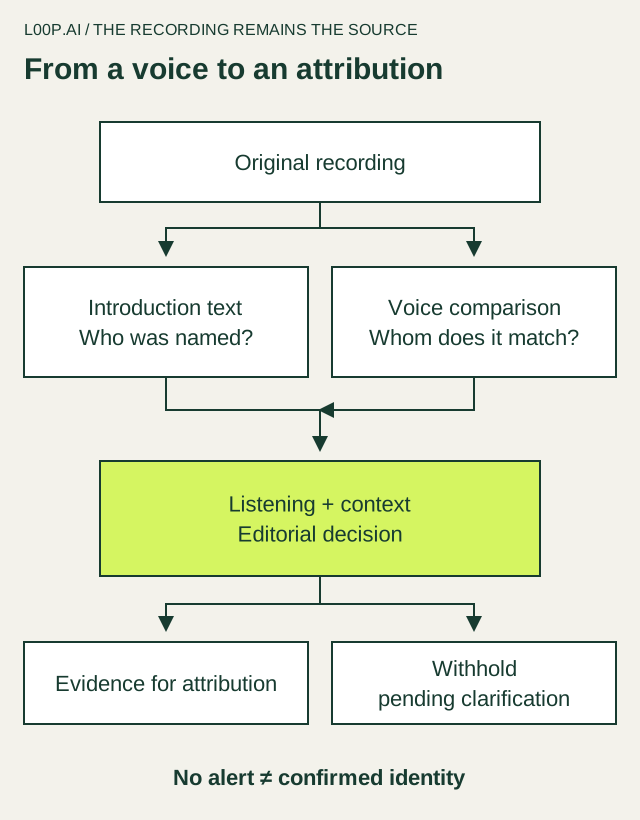
The diagram separates source material, supporting clues and an editorial decision. Introduction text and voice comparison can complement each other, but they can also lead jointly to an error. Absence of contradiction is not independent confirmation of identity.
05 / What we actually checked
On 26 September, we locally tested a conflict rule from the retrieved version of code used in the Głosoteka project. The function received ready-made fictional records: a bank name and an introduction name, with confidence states. It did not listen to audio. We ran no models, accessed no real voice bank and did not test the complete deployment.
Six code-behaviour cases were checked. Two different names with the required input states produced a conflict signal. Matching names, an unrecognised voice or insufficient introduction confidence did not. In a separate case, two different first names with the same surname also produced no conflict signal.
This is an important limit: “no alert” does not mean “the same person”. Six results matching the expected code behaviour are not six correct identifications. The trial record — PL/EN JSON discloses fictional inputs, observations and the scope of the check, without broadcast participants' data.
06 / Accept the attribution, not just a message
Before using a named quotation, check a passage that includes the introduction and answer. Compare the full name, voice order and any correction. Establish whether it is recorded material or a statement about someone absent. Verify role and position separately: vocal similarity does not confirm someone's job title.
If there is a conflict, retain both suggestions and the reason for withholding the name. If evidence is insufficient, keep a neutral description or refer the material for clarification. Do not fill in a name from the schedule solely because that person normally hosts the programme. Plans may differ from recordings.
Similarly, a faithful quotation does not confirm a fact: an accurately transcribed introduction establishes the words spoken, not automatically the truth of every claim they contain.
07 / A short card before the conversation
Establish participants and the agreed attribution. Introduce people at their first turn, restore context after breaks, and label clips and corrections. Afterwards, retain the recording, important timestamps and unresolved attributions. Consider permission for public attribution and voice-use rules separately from the technical ability to match voices.
If a participant is to remain anonymous, do not use a tool to circumvent that agreement. Do not add a voice reference to a bank merely because a recording is available. The scope of that use needs separate agreement.
We can help turn your interview practice into an acceptance checklist and attribution rules. A description of the process is enough to begin; private recordings and participant data need not appear in a public example.
08 / Provenance and the next measurement
We read the handbook, the current conflict rule, its text-processing dependencies and existing test cases. The editorial method and cited scope of pyannoteAI documentation were reviewed on 26 September 2026. We do not carry over the handbook's thresholds, prices, processing times or assurance that an introduction is sufficient for correct attribution.
Codex prepared the PL/EN text, original SVG and trial record. Review is by the author, without an independent second model. No third-party recordings or illustrations were used. An acoustic test on appropriately licensed material with confirmed speaker identities remains a separate task. A rule change, example error or that measurement triggers another review. A human may withdraw the publication.