
The denominator changes what a result means
Seventeen hours can mean 20% of a sample or 14.29% of the full window. Define time, missing evidence and comparisons so that correct arithmetic does not lead to a wrong decision.
2026-09-25 · 1.0 · PL / EN
01 / Before trusting a percentage
A report shows 20% current-affairs content. A station owner wants to know whether that is a lot, a little, or enough to meet a programming obligation. The number alone cannot answer. It may describe the whole broadcast week, the recordings retained, speech alone, or the sample of hours matched against the previous week. Each calculation answers a different question.
The denominator defines the whole against which a share is measured. We do not choose it because that happens to be the collection the system managed to process. First define the question and the metric's basis; then establish how much of that whole is known. This order prevents a report from improving its result when data disappears.
This article adapts two workshop notes on denominators and weekly comparisons. The example is invented. It is not an on-air measurement, a statement of Radio Wnet's current obligations or a binding assessment of licence compliance.
02 / The form shows where to look
In KRRiT's published form no. 2, page 2, tables C.4 and C.5 express shares relative to weekly programme time between 06:00 and 23:00. C.4 specifies the spoken component of programmes. Field C.1 separately concerns monthly airtime of songs with lyrics. One page thus uses different periods and different reference sets. The form was downloaded and checked on 25 September 2026.
This is a guide to reading the documents, not a universal set of thresholds for every station. A real report must connect each metric to the broadcaster's applicable decision, its annexes and amendments, and the relevant legislation. A blank form does not establish an individual obligation. This exercise does not calculate the additional rules or exceptions governing monthly language quotas.
Assuming seven full broadcast days in the 06:00–23:00 window gives 7 × 17 = 119 hours, or 7,140 minutes and 428,400 seconds. This is an explicit assumption of our example. A round-the-clock week without a clock change has 168 hours, but substituting that number would change the question's scope. The length of the processed archive cannot replace the assumed 119 hours either.
03 / The same 17 hours, two different shares
Our invented station has 119 programme hours in the window under review. We have complete, accounted-for sources for 85 hours. Within them, 17 hours are confirmed as belonging to the selected category and 68 hours as outside it. The remaining 34 hours lack sufficient evidence. Teaching assumptions: classification of the known 85 hours is correct, intervals do not overlap, and a category cannot occupy more time than an interval contains.
- Share within the known subset: 17 / 85 = 20%.
- Observed category time relative to the full window: 17 / 119 ≈ 14.29%.
- Window coverage: 85 / 119 ≈ 71.43%.
- Unknown time: 34 / 119 ≈ 28.57%.
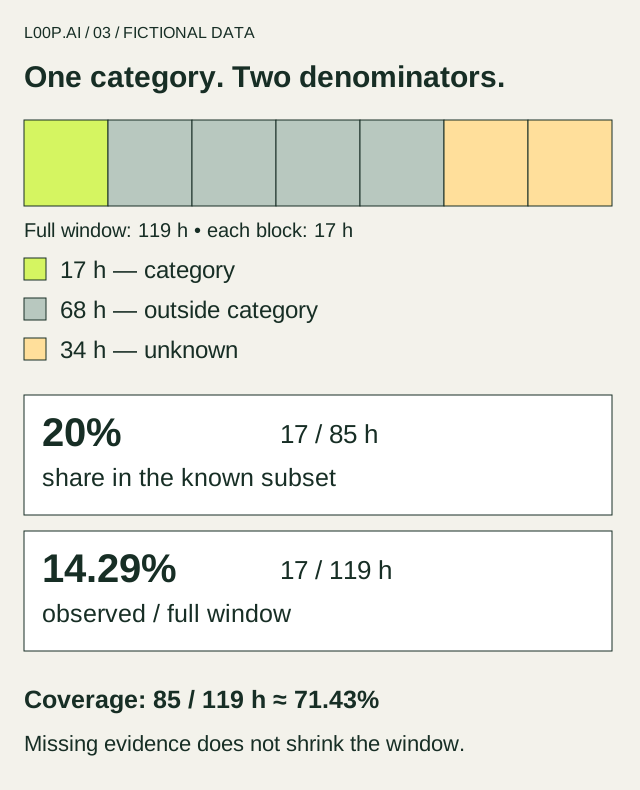
If none of the unknown hours belonged to the category, the full share would be 17/119. If all of them did, it would be (17 + 34)/119 ≈ 42.86%. Under the stated assumptions, the possible share therefore lies between 14.29% and 42.86%. These are bounds resulting from missing evidence, not a confidence interval or a forecast. They do not justify assigning an arbitrary midpoint to the unknown hours.
If all 119 hours were missing, coverage would be 0%, the share in the known subset would be undetermined, and the bounds for the whole would be 0–100%. If all hours were accounted for, the two denominators would coincide and the gap would disappear. Round only for display; retain seconds and full precision in the calculation.
04 / A voice is not yet a programme category
An acoustic detector can identify speech, music and other sounds. It cannot by itself decide whether a conversation is news, current affairs, sport or advertising. A transcript helps establish content, but word count does not replace airtime. Nor does a programme title automatically describe every minute it contains.
Suppose a half-hour programme contains 20 minutes of conversation and a separate 10 minutes of songs. If the conversation meets the chosen spoken-content category's criteria, its contribution is 20 minutes, not 30. Speech over background music requires an explicit rule for overlapping layers; two simultaneous tracks cannot be added as twice the broadcast duration.
Keep acoustic measurement, content classification and metric calculation separate. Local relevance or repeat status may be additional attributes of the same interval. Do not add a subset to its parent category a second time. Do not calculate music as 100% minus speech: other sounds, messages and missing evidence need their own accounting.
In the demonstration, the denominator is the entire assumed window and advertising is not subtracted. For a legal obligation, rules for including airtime and classifying messages must come from the applicable basis. A voice in an advertisement does not automatically qualify it as current-affairs content.
05 / Define the metric before running the model
Before calculating a percentage, write a short metric record that both a person and a program can read. This is a proposed method, not a claim about an existing product interface.
- Question: what share is being measured and which decision it supports.
- Numerator: qualifying seconds, assignment criteria, recording sources and timestamps.
- Denominator: the full defined collection, unit, inclusion and exclusion rules.
- Period: exact dates, time window, Europe/Warsaw time zone and an exclusive end.
- Basis: the document, version, provision and scope; or the exercise's explicit assumption.
- Completeness: known time, missing sources and time with uncertain classification.
- Method: versions of rules, model and settings, including any fallback used to estimate duration.
- Review: who checked the audio, boundaries and classification, and which cases still need a decision.
An exclusive end means that 06:00–23:00 includes the start at 06:00, while the instant 23:00 belongs to the next interval. Split segments crossing a day or hour boundary by broadcast time. Processing the same segment again does not create additional airtime.
A model's assessment remains an estimate requiring review. If a model assigns 60% of a ten-minute segment to a category, that method produces an estimated six minutes. This does not mean six minutes confirmed by listening. Model confidence is a separate field; multiplying duration by confidence would change the metric's definition.
06 / Compare matched samples
A week with five mornings is not comparable with a collection consisting mainly of weekend material. To analyse change, match corresponding weekdays and hours calculated with the same method. State the number of pairs and their total duration. No pairs means no comparison, not a zero trend.
Example: the category occupies 72 minutes in six matched hours from the previous week and 90 minutes in the corresponding six hours of the current week. The shares are 20% and 25%. The difference is 5 percentage points; the relative increase is 25%. Both statements concern only that six-hour sample. They do not automatically describe the full week or fulfilment of a programming minimum.
Changing the model or criteria can change a result even when the broadcast stays the same. Preserve the old edition. Compare a new method on the same reference material and label the recalculation separately. Record the organisational choice of when a week begins; do not present an editorial choice as a general rule imposed by the regulator.
07 / What the reader needs from a report
A reader needs the result, its basis and the limits of the evidence together. In our example, a sound description is: “We found 17 category hours in the known 85 of 119 hours. That is 20% of the known subset and 14.29% of the full window. Thirty-four hours are missing; the full share has not been established.” A bare “20%” hides the essential information.
Do not automatically award a green compliance status from a partial sample. That conclusion also requires correct classification, the complete basis of the obligation and a rule for evaluating missing evidence. This example does not implement such an assessment. Keep evidence references, the reason for an undetermined result and the trigger for recalculation in the report.
After missing recordings are added, issue a new revision with a description of the changes. Do not silently replace the old result. The reader can then distinguish a change in broadcasting from a change in data completeness or method.
08 / Sources and scope of this edition
The adaptation draws on the internal notes “KRRiT denominators” and “Weekly method”, dated 11 September 2026 and read in full. We share the method and original examples, excluding private broadcast data, contractual records and claims about the modules' current deployment status.
The public reference is the KRRiT forms page and form no. 2 linked above: C.1, C.4 and C.5 on page 2. Checking the form does not establish that every decision received by an individual broadcaster has been located. Individual thresholds, exceptions and disputed interpretations require separate verification before a legal assessment.
Codex prepared the PL/EN text, fictional data and diagram; selection came from the joint Claude Code and Codex ranking. This is an author-reviewed edition, not an independent review by a second model. Human oversight follows publication and permits withdrawal. Calculation errors, method changes or changes to the cited form trigger correction.