
No result is not zero
An automation failure can look like an ordinary number. Here is how to preserve what a system could not establish, from the measurement itself to an organisation owner’s decision.
2026-09-25 · 1.0 · PL / EN
01 / A number that should not exist
Imagine a report covering one hundred documents. A category that matters to your organisation shows “60%”. You cannot tell whether the system read every document, found the category in sixty and ruled it out in forty. Perhaps twenty documents could not be opened at all. These situations call for different decisions, even though the screen can display the same number.
At L00P.AI we describe this as a “silent zero”: a processing stage cannot establish a result but passes an ordinary value downstream. Later stages no longer have enough information to recover the distinction. A polished chart and a fluent explanation may simply distribute the error more effectively.
This matters when working with recordings, documents and archives. No detected speech can mean silence or a model that did not run. No document found can mean an absent document or an incomplete index. An empty music list can mean no music or a failed identification stage. The first task is to establish which situation actually occurred.
02 / Three states, each with a different meaning
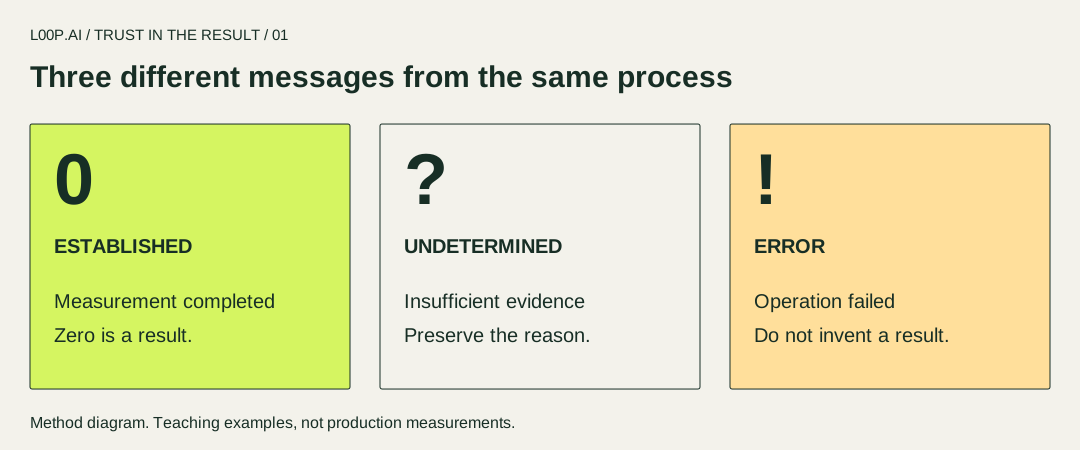
Established: the operation completed and its result meets the agreed conditions. Its value may legitimately be zero. A checked recording segment, for instance, may contain none of the event being sought. That zero is meaningful and must be preserved.
Undetermined: the material was considered but cannot support an answer under the chosen method. A speaker may be obscured, a classification ambiguous or a document incomplete. This state needs a reason so that the recipient knows what is missing.
Error: the operation did not complete correctly. A file could not be opened, a tool was unavailable or a time limit was reached. This describes the process, not the material. A public message should use a safe reason category rather than exposing secrets from a technical exception.
These states do not settle whether a classification is true. An established result can still be wrong. They distinguish an assessment that needs checking from an assessment that was never obtained.
03 / See what the denominator changes
This example is entirely invented. Out of one hundred documents, sixty belong to a selected category, twenty do not and twenty have no established result. The category’s share among established cases is 60 / 80 = 75%. Coverage is 80 / 100 = 80%. Twenty cases remain unknown.
If missing results were silently treated as “no”, the report would show 60%. If they were treated as “yes”, it would show 80%. A transparent report therefore carries three facts: 75% within the established subset, 80% coverage and 20 undetermined cases. Across the full collection, the possible share ranges from 60% to 80%, assuming the established classifications are correct.
LAB / SYNTHETIC DATA
The same category. Less and less evidence.
60 in the category, 20 outside it, 20 without a result.
The slider runs locally in your browser. It sends no data. Without JavaScript, the example described in the article remains visible.
The slider changes the number of missing results. In this teaching example, the category keeps its 75% share within the established subset while the bounds for the full collection widen as the gap grows. If every result is missing, the subset percentage cannot be calculated. The interface should say “not calculated”, not zero.
A percentage calculated after excluding missing results is not automatically an estimate of the whole collection. The gaps may concern harder documents, a different language or poorer audio. Correct division does not fix selection bias. The displayed bounds are neither a confidence interval nor a measure of model accuracy.
04 / Information that must survive the whole journey
A result should travel with its state, its reason for being unavailable and the identifier of the source material. For recordings, it also needs the start and end of the relevant segment. A reviewer can then return to a precise listening point instead of searching through an entire archive.
A simple contract keeps downstream tools from confusing the cases. An established result carries a value; an undetermined result carries no value and a reason; an error carries no value and a failure category. The following record is an illustration, not a claim about an existing Szpieg+ API format.
[
  {"state": "established", "value": 0, "reason": null},
  {"state": "undetermined", "value": null, "reason": "insufficient_data"},
  {"state": "error", "value": null, "reason": "tool_unavailable"}
]
A percentage report should expose its numerator, denominator and the counts of undetermined cases and errors. It must define its unit: a document, an utterance or a second of audio. The share of segment counts must not be confused with the share of recording time. Tables, charts and language-model commentary must use the same definition.
05 / Two models do not automatically establish the truth
A second transcription, for example one produced locally with Whisper, can be compared with the first to locate passages for listening. A disagreement is a review signal. Agreement does not prove accuracy because both systems may have made the same mistake.
The comparison should therefore retain the original recording, both text versions, their time boundaries and the correction decision. The same principle applies to music removal. Detected segments can help produce a working speech-only copy, while ambiguous segments stay visible in a listening list. The altered file does not replace the original.
This is an application of the rule, not a Whisper benchmark or a measurement of music-detection performance. This edition checks the arithmetic and the demonstrator. Model quality requires a separate test on material with documented provenance.
06 / A test designed to break something
Acceptance testing should include a controlled absence. Give the system an unreadable file, a deliberately unavailable tool or an empty data range. Check whether the missing result remains visible on the final screen instead of being buried in a technical log.
- With the measurement tool unavailable, the result must be an error rather than zero.
- Ambiguous material must preserve an undetermined state and its reason.
- A correctly measured zero must remain a genuine zero.
- With no established cases, the system must neither divide by zero nor display 0%.
- After changing aggregation, calculate an example by hand and compare every published format.
There is no requirement that every indicator should decrease after a fix. The direction depends on the old error and the definition of the measure. The requirement is that the new value can be explained, excluded cases can be shown and the calculation can be reproduced.
07 / The owner defines what is good enough
A universal acceptable threshold for missing results would create false precision. A gap in a working search has different consequences from a gap in an externally published report. The person running the organisation understands the cost of a mistaken decision. Scope, measurement units, stopping thresholds and exception handling should be agreed with that person.
A useful question is: which decision would change if you learned that the system had not assessed one fifth of the material at all? The answer helps place a control where the result will actually be used. A shared workshop starts with that concrete conversation about the organisation’s process.
08 / Provenance and limits of this edition
This article adapts the internal specification “Zakaz cichych zer — reguła dla całego potoku” of 22 September 2026 and the RD-044 diagnostic record of 20 September. The sources were read during the Resources ranking work on 25 September. A specification describes a requirement; its existence is not evidence of complete implementation. Internal operational figures have been replaced with an explicitly synthetic example.
The internal ticket itself is not published. This is a complete public explanation of the method, with identical prose in HTML and Markdown, section metadata for future retrieval and an interactive demonstrator. The illustration is a diagram constructed in code, not an application screenshot or a real measurement.
Edition 1.0 was prepared and published by the Codex agent at Lech R. Rustecki’s request. The topic comes from the combined Claude Code and Codex ranking. Lech receives a notification after publication and can withdraw the material. This is not labelled as prior human approval of the article.
A changed rule or an error in the example triggers a new edition with a change record. This page belongs to the “Trust in the result” series. The series publication cadence does not advance this article’s verification date.